
India's unemployment rate witnessed a sharp decline to 6.57 per cent in January, the lowest since March 2021, as the country gradually recovers with easing of restrictions following a decline in Omicron cases, according to CMIE. While unemployment in urban India stood at 8.16 per cent in January, in rural areas it was the lowest at 5.84 per cent, as per data by independent think-tank Centre for Monitoring Indian Economy (CMIE). In December, the unemployment rate stood at 7.91 per cent, with urban at 9.30 per cent and rural at 7.28 per cent, it added.

India's unemployed, the report said, were mostly those with higher education degrees and the young.

An overwhelming proportion of the unemployed declare their nature of occupation as students. In the quarter ended December 2021, 77% of the unemployed who were actively looking for jobs were students. This syncs well with another data, that 77% of the unemployed are between 15 and 24 years of age, reveals Mahesh Vyas.

India's unemployment rose to a three-month high in March to 7.8 per cent as the country's labour markets deteriorated, according to data from the Centre for Monitoring Indian Economy (CMIE). Unemployment rate in the country surged in December 2022 to 8.30 per cent but declined in January to 7.14 per cent. It edged up again in February to 7.45 per cent, the CMIE data released on Saturday showed. During March, the unemployment rate in urban areas was at 8.4 per cent while in the rural areas it was at 7.5 per cent.

Economists on Tuesday are not convinced about the latest monthly unemployment data released by the Centre for Monitoring India Economy (CMIE), particularly about the statistics of the rural areas. They asserted that it is difficult to get the real picture of unemployment from the methodology used by the CMIE to get the data. The overall unemployment rate in India has increased to 7.83 per cent in April 2022 as compared to 7.60 per cent in the previous month, CMIE said in its report.

'The government should come back as a job creator as it did in the 1960s and the 1970s.'

The rate of unemployment was the highest in the urban areas, which constitute the most number of red zones due to the COVID-19 cases, at 29.22 per cent, as against 26.69 per cent for the rural areas.

Unemployment rate in the country has zoomed to a high of 8.3 per cent in December, the highest in 2022, according to data from Centre for Monitoring Indian Economy (CMIE). The unemployment rate during November was at 8 per cent, while in September it was the lowest at 6.43 per cent and was at the second highest level during the year at 8.28 per cent in August, the CMIE data stated. While the urban unemployment rate was at 10 per cent during the last month of 2022, rural joblessness stood at 7.5 per cent during December.
India's unemployment rate surged to a one-year high of 8.3 per cent in August as employment sequentially fell by 2 million to 394.6 million, according to data from the Centre for Monitoring Indian Economy (CMIE). During July, the unemployment rate was at 6.8 per cent and the employment was 397 million, the CMIE data added. "The urban unemployment rate is usually higher at about 8 per cent than the rural unemployment rate, which is usually around 7 per cent.

The unemployment rate for women was last this low around Diwali in 2022. The unemployment rate has dropped for women from 14.9 per cent in December 2023 to 11 per cent in January 2024, according to data from the Centre for Monitoring Indian Economy (CMIE). It was higher in January 2023 at 13.5 per cent.

'When you do some job for a few hours, you are hardly earning enough to survive.'

Generative AI is transforming workplaces but at a cost -- there are fewer jobs for young workers just entering the workforce, reveals a Goldman Sachs report.
The country's unemployment rate in July fell to 6.80 per cent, the lowest level in the last six months, amid rising agriculture activities during monsoon, according to Centre for Monitoring Indian Economy (CMIE) data. The unemployment rate dropped to 6.80 per cent in July from 7.80 per cent in June, the CMIE data said. Rural unemployment declined 6.14 per cent to 272.1 million last month from 265.2 million or 8.03 per cent in June, it said.

The unemployment rate shot up to a record 10.9 per cent in the week that ended on December 18, points out Mahesh Vyas.

May 2021 will end with double-digit unemployment rate, falling employment rate and substantial loss of employment, points out Mahesh Vyas.
'Unemployment barely figures in the Budget except as a derived demand from the industry and infrastructure.' 'There is no effort at direct attack on unemployment.'

Employment in India saw a V-shaped recovery after being adversely impacted between April and June 2020 during the Covid lockdown and during April-June 2021, when the second wave struck, said Krishnamurthy V Subramanian, former chief economic advisor, in a paper released on Friday. Subramanian is now serving as executive director of the International Monetary Fund (IMF). From the official survey data of the National Sample Survey Organisation (NSSO), the paper titled 'Employment in India: Data Sources, Facts, and Trends' showed that both worker-population ratio (WPR) and labour force participation rate (LFPR) were higher, while the unemployment rate was lower during October-December 2022 when compared to the corresponding quarter in 2019.
Niti Aayog vice-chairman Rajiv Kumar debunked claims of jobless growth, saying how can a country grow at an average of 7 per cent without employment.

Urban employment rate increased to 34.96 per cent in February. This is the highest employment rate recorded in urban India since September 2020.

Unemployment was worse only in the pre-demonetisation period, according to the data, at 9.6 per cent in August 2016.
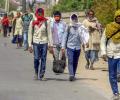
The count of the unemployed mounted to 38.7 million in December 2020 compared to 27.4 million in November, registering a massive increase of 11.3 million, reveals Mahesh Vyas.

Households with only one employed person can be considered to be somewhat vulnerable. Their proportion is rising. Also rising is the proportion of highly vulnerable households with no person employed, observes Mahesh Vyas.

'In India, a large proportion of the labour force does not have a regular job.' 'People are mostly employed as daily wage workers, agricultural labourers, small farmers and self-employed traders.' 'These move in and out of "jobs" fairly rapidly.' 'It is the high proportion of these workers in India that makes unemployment volatile,' explains Mahesh Vyas.

'In May 2020-2021, nearly 10 crores (100 million) lost jobs. 'Covid is not the reason for the present crisis. It aggravated the crisis.'

'It does not look like unemployment is a priority for the government.' 'If there was one external factor which could have made an impact on low investment and low jobs, it was the Budget and it has not made any difference.' '2020 is going to be a difficult and challenging year.'
The number of fresh formal jobs generated in a month increased to a seven-month high in April, signalling a recovery in the formal labour market in the country, according to the latest monthly payroll data released by the Employees' Provident Fund Organisation (EPFO) on Thursday. In April, the number of new monthly subscribers under the Employees' Provident Fund (EPF) sequentially increased by 18.77 per cent to 887,438 from 747,146 in March.

'The high unemployment rate being witnessed today is not only the highest in three years but is far more debilitating for the economy than the similar unemployment rates witnessed in 2016,' says Mahesh Vyas.

There is an attempt to brush aside the results of all surveys that point to a deteriorating jobs situation. This is counter-productive, says Mahesh Vyas.

'According to CMIE data, employment in manufacturing saw a reduction from 51 million in the country in 2016 to 27 million in 2021. 'That is, it has halved in just 5 years. 'At the same time, the national lockdown resulted in reverse migration to rural areas, and an increase in the number of workers in agriculture. 'It also means joblessness has increased in agriculture because there are too many workers; the number of workers went up from 200 million to 232 million.'

Rising unemployment rate reflects a rise in the labour participation rate, which in India's case has been worryingly low.

The Congress has been accusing the government of distracting people with other issues to hide its failures and issues of price rise and unemployment.

In 2022-2023, 15.5 per cent of women were unemployed compared to 11.2 per cent in 2017-2018. For every one woman employed, 10 men got a job.
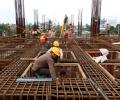
It would be larger than even in the pandemic year of 2020-2021, notes Mahesh Vyas.
Only West Asia and North Africa have a lower employment rate than India, points out Mahesh Vyas.

'The noise that we are hearing is because the five big IT players are not hiring significantly.'

Go beyond the curriculum. Talk to experts. Build your network, says Dr NV Raghavendra.

'The China opportunity, the digital opportunity and the end of geography opportunity are the three pieces of luck India got due to Covid.'

The loss of job opportunities in recent times has been so severe that labour stopped even looking for jobs, says Mahesh Vyas.

The fall in the employment rate translated into a 2.6 million fall in absolute employment between December 2022 and March 2023. Most of this fall was in March 2023.
Fresh formal job creation cooled for the second consecutive month to decline to a six-month low in September, signalling a downturn in the labour markets this financial year. The number of new monthly subscribers under the Employees' Provident Fund (EPF) declined by 6.45 per cent to 891,583 in September from 953,092 in August, shows the latest payroll data released by the Employees' Provident Fund Organisation (EPFO). Besides, the net payroll additions -- calculated by taking into account the number of new subscribers, the number of exits, and the return of old subscribers -- increased by 14.9 per cent to 1.72 million in September from 1.49 million in August.
 © 2026 Rediff.com - Advertise with us - Disclaimer - Privacy Policy - Sitemap - Feedback - About us - Terms of use - Grievances